No manual reconciliation
The CapEx/OpEx split that usually gets rebuilt by hand once a quarter for finance updates automatically as work gets classified — no spreadsheet, no separate process.
FEATURE
Every completed item classified as CapEx or OpEx — by the same configurable rules behind every other breakdown, not a spreadsheet someone reconciles once a quarter.
New to CapEx/OpEx classification for engineering work? Read our plain-English guide to what it means and why it matters.
Classifies every completed work item as CapEx (capitalizable — usually new product development) or OpEx (operating expense — usually maintenance, support, bug fixes), with a live breakdown on the org-wide dashboard and on each team's page: how much is CapEx, how much is OpEx, and how much is still unclassified. A 12-week stacked trend chart on the team's overview shows how that split has moved over time, not just where it stands today.
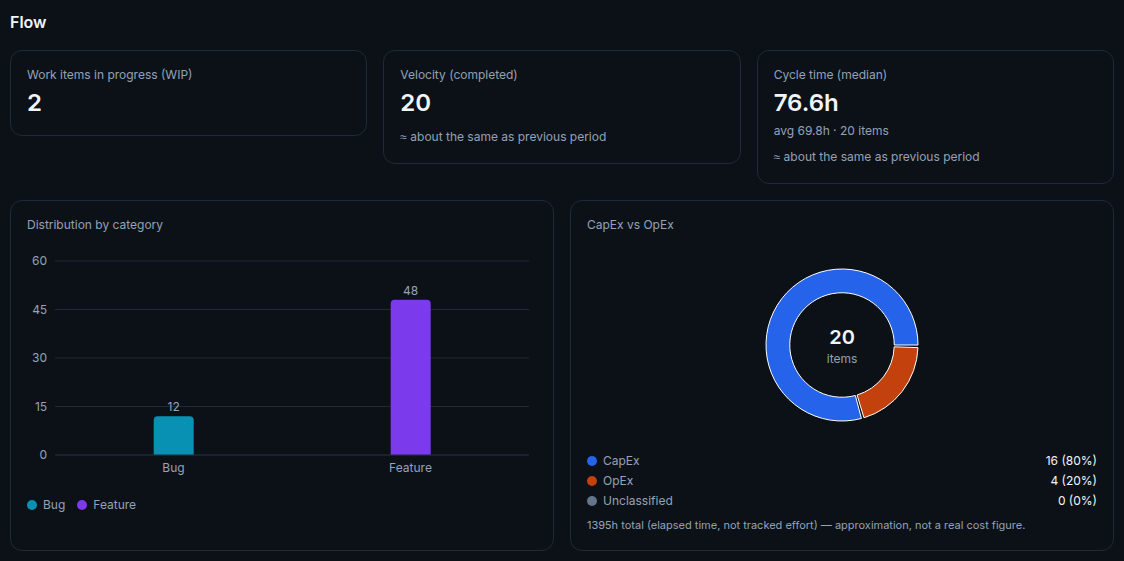
Illustrative data, for demonstration purposes only.
Four real screens, in order — this is Semantic Rules → Cost classification, not a mockup.
Semantic Rules opens with nothing configured for this scope — "0 of 6" — every category falls back to the system default until you set a rule. Nothing is guessed silently.
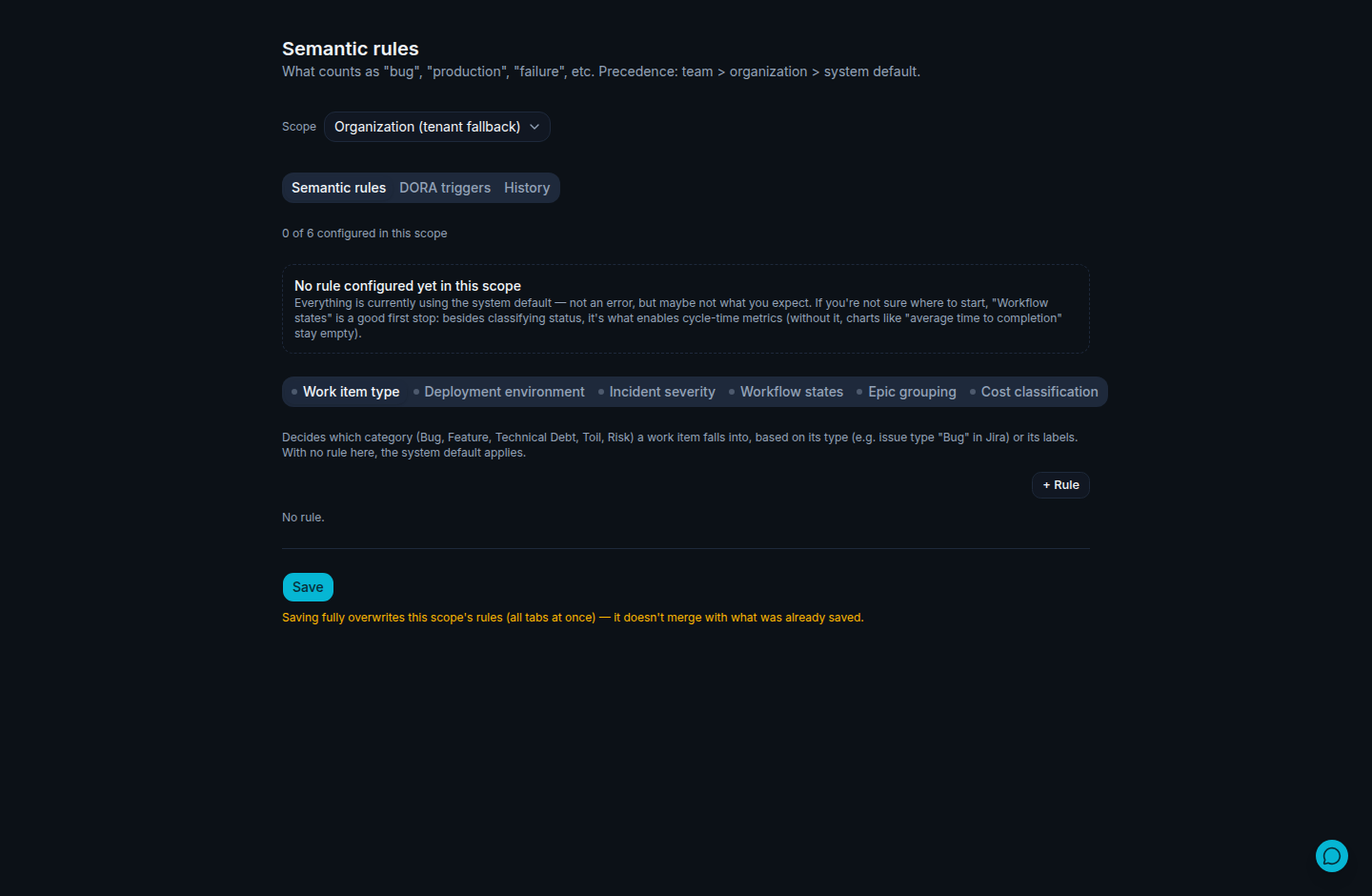
Illustrative data, for demonstration purposes only.
The 6th family, right next to the 5 you already use for Bug/Feature/Technical Debt/Toil/Risk — same page, same team-beats-organization-beats-system precedence. All 5 categories start Unclassified.
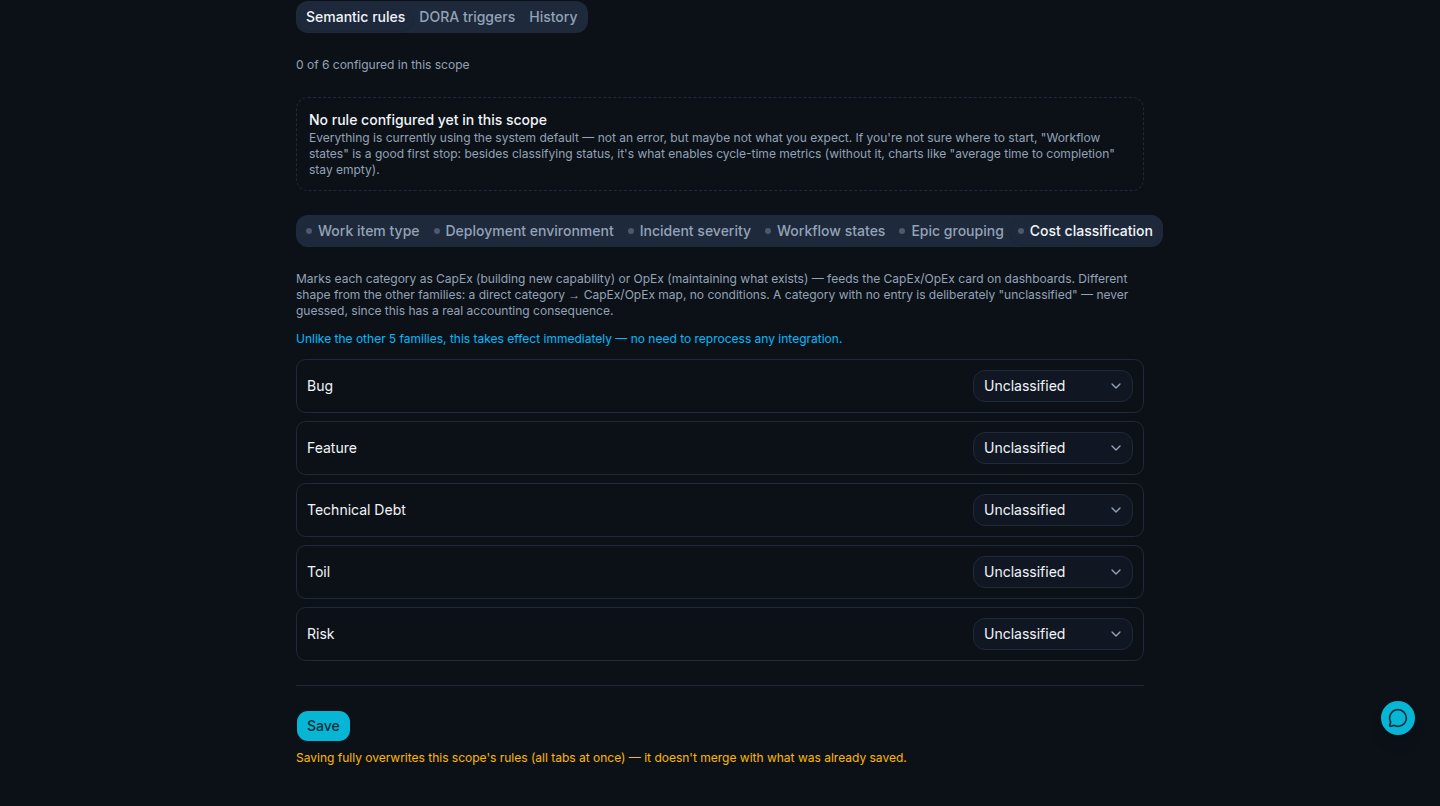
Illustrative data, for demonstration purposes only.
No conditions to write — just a direct category → CapEx/OpEx map. A category left blank stays deliberately Unclassified, since this has a real accounting consequence and shouldn't be guessed.
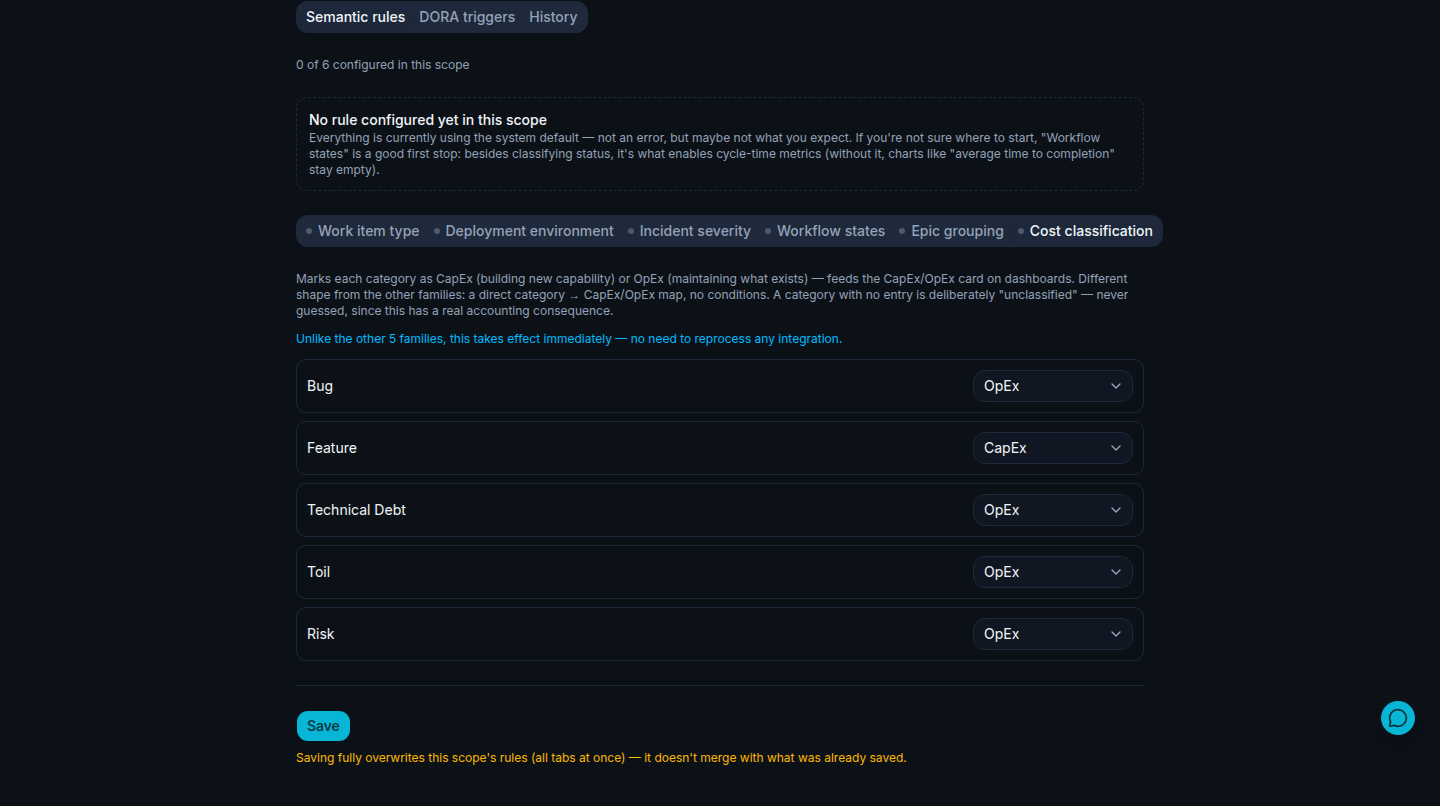
Illustrative data, for demonstration purposes only.
Unlike the other 5 rule families, this one doesn't need a reprocess. The dashboard's CapEx/OpEx card updates right away — no re-sync, no waiting for the next integration run.
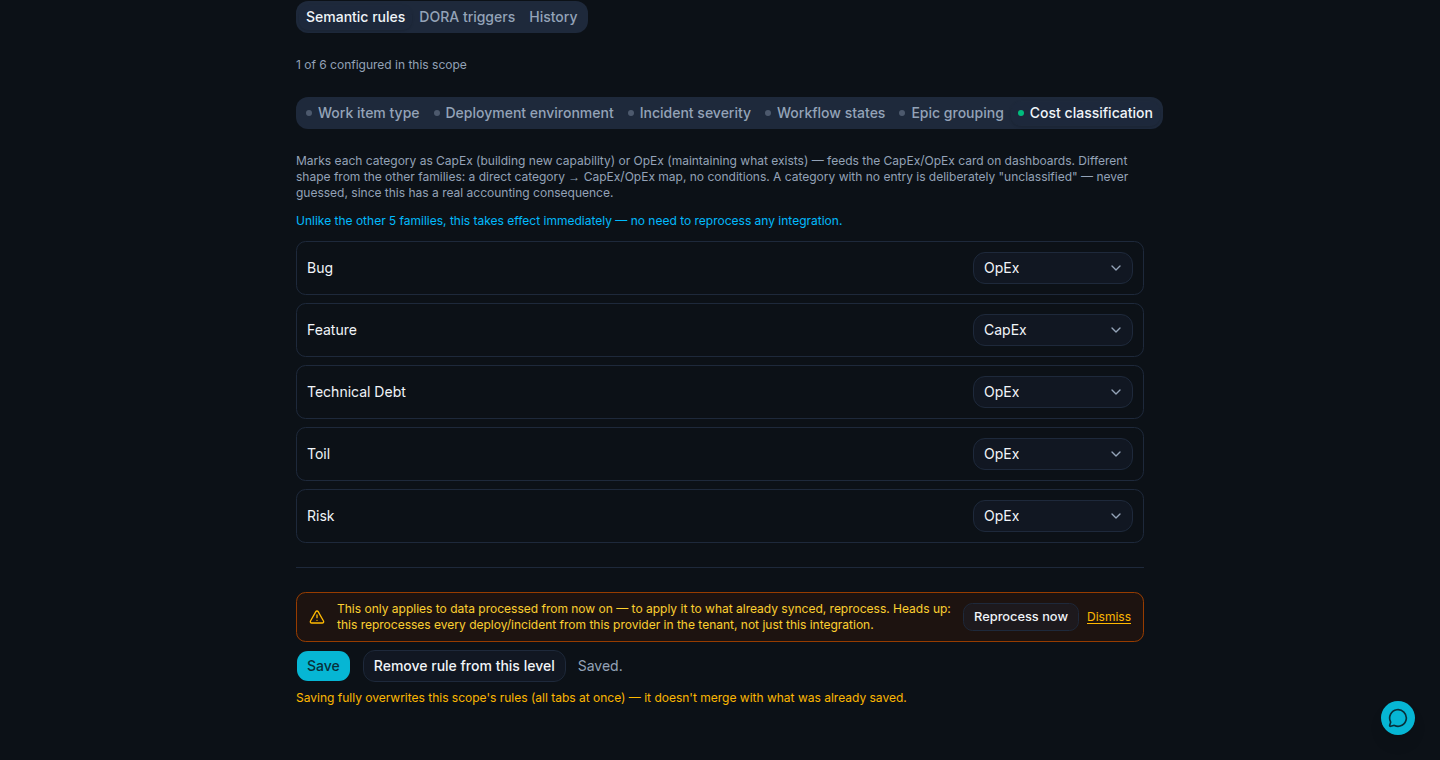
Illustrative data, for demonstration purposes only.
The CapEx/OpEx split that usually gets rebuilt by hand once a quarter for finance updates automatically as work gets classified — no spreadsheet, no separate process.
Not a separate system — the same semantic rules (and the same team-beats-org-beats-system precedence) already used for the Flow Metrics categories (Bug/Feature/Technical Debt/Toil/Risk), applied to a second dimension.
An item with no matching rule shows up as its own category — with a link straight to where you'd fix it — instead of silently defaulting to one side or the other.
A 12-week stacked view per team shows whether the CapEx/OpEx mix is shifting, not just a single number frozen in time.
No — it's a classification of engineering work by rules your team defines, not an accounting opinion. Treat the breakdown as a well-organized input to that conversation, not a substitute for it.
They show up as "unclassified" on the dashboard — visible, not silently bucketed into CapEx or OpEx by default — with a direct link to Semantic Rules to add the missing rule.
Yes — a team's own rule takes precedence over the company-wide default, the same cascade used for every other semantic rule on the platform.