GUIDE
Rework & Review Health: What They Measure and Why They Matter
How much shipped code gets rewritten soon after, and how many pull requests merge without a single reviewer — two early warning signs for a quality problem, before it becomes an incident.
What they measure
Rework rate is the share of merged code that gets significantly rewritten again within a short window (14 days) of shipping — a proxy for code that didn't actually solve the problem the first time. Review health is the share of merged pull requests that went out with zero reviewers — a direct measure of how much of a team's shipped code never got a second pair of eyes before merging. They're grouped together because they answer a related question from two different angles: is what's getting shipped actually solid, and is the process meant to catch problems before shipping actually being used.
Why it matters
Both signals catch a quality problem well before it shows up as an incident, a customer bug report, or a DORA change failure rate spike. A rising rework rate usually means requirements weren't clear, the first attempt was rushed, or a team is quietly accumulating a specific kind of technical debt — all worth knowing before it compounds. A team that regularly merges PRs without review isn't necessarily doing bad work, but it has removed one of the cheapest quality checks available, and that decision is easy to make by accident, one urgent hotfix at a time, without anyone deciding it should become the norm.
How to calculate it
Rework rate: for merged code, check whether a meaningful portion of the same lines get changed again within 14 days of the original merge, and divide the count of reworked changes by total merged changes over the period. Review health: divide the count of merged PRs that had zero approving or commenting reviewers by the total merged PRs over the period.
A worked example: a team merges 40 PRs in a month. If 6 of those PRs see significant rework within 14 days, that's a 15% rework rate. If 8 of the 40 merged with no reviewer at all, that's a 20% no-review rate — worth checking whether those 8 overlap with the 6 that needed rework.
How to interpret the numbers
Neither has a published industry benchmark the way DORA metrics do — what counts as "rework" depends on how a team's own workflow and branching strategy define a rewrite, and what's an acceptable no-review rate varies by how much a team relies on pairing or trunk-based practices instead of formal PR review. The useful comparison is a team against its own recent trend, and checking whether the two numbers correlate — a team where no-review PRs and reworked PRs overlap heavily has a much clearer story than one where they don't.
A common trap
It's tempting to treat "zero reviewers" as always a process failure, but a team that pairs in real time on most changes may legitimately skip a separate PR review without any quality gap — the review already happened, just not as a GitHub approval. The number is most useful as a starting question ("why does this team's PR review rate look different from the others?"), not as a rule that every merge needs a formal reviewer regardless of how the team actually works.
How moasy.tech computes it
moasy.tech recalculates both signals from synced pull-request history — no manual audit of individual PRs required. Rework rate and review health sit next to contribution concentration on the same team quality view, since all three draw on the same underlying pull-request and work-item data synced from Jira, Linear, GitHub or Azure DevOps.
See the full implementation on the Capacity & Workload feature page, or back up to Team Health for the other signals in this cluster.
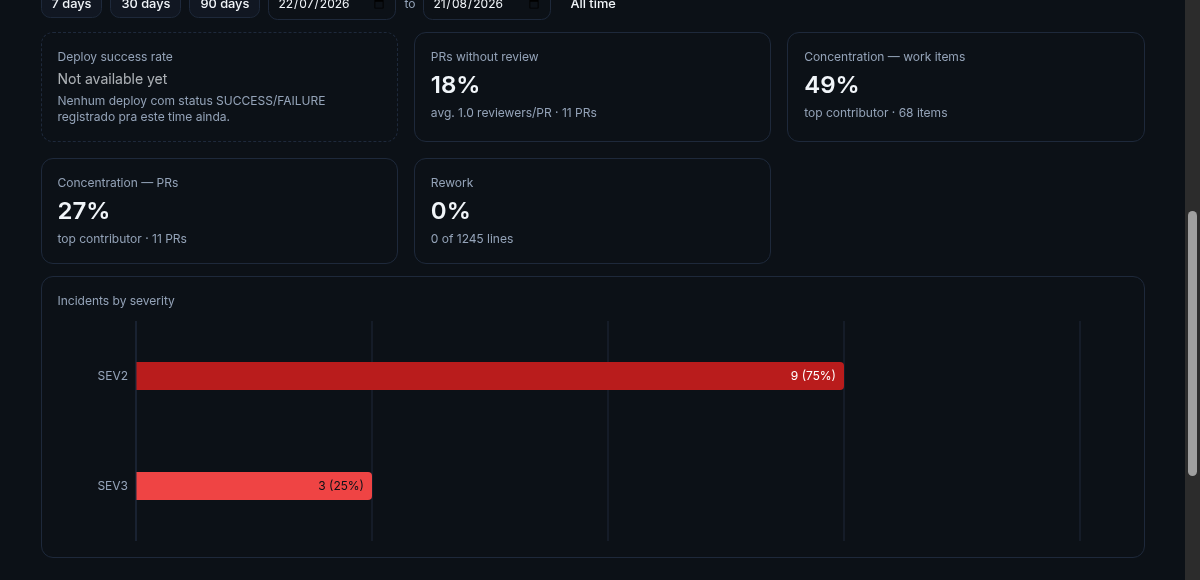
Illustrative data, for demonstration purposes only.
Questions about rework and review health
Does high rework always mean poor code quality?
Not necessarily — it can also mean requirements shifted after the original merge, or scope was intentionally staged across multiple PRs. It's a signal worth investigating, not an automatic verdict on the code itself.
Does a "no reviewer" PR mean nobody looked at the code?
It means no one approved or commented on it as a GitHub/tracker reviewer — it doesn't rule out review that happened outside that workflow, like live pairing, which the metric can't see.
Are these used to evaluate individual engineers?
No — both are team-level signals about process and outcomes, not an individual's review or coding performance.
See your own rework and review health
Get started free